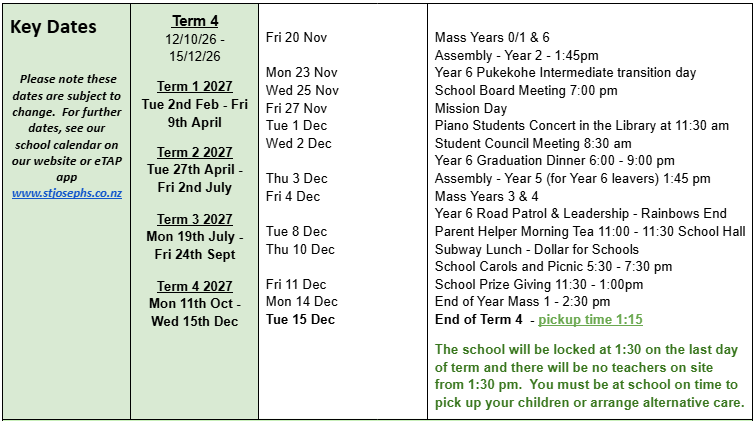
Term Dates 2026
Term 4 – Monday 12th October – Tuesday 15th December pick up 1:15pm sharp.
Please email the office if your children are taking a holiday during the school term. stjoesoffice@stjosephs.co.nz
Term 4 School Attendance Dues should now be paid.
ASB account: St Joseph’s School (Pukekohe) Board 12-3023-0338374-01 ref: student’s name
These can also be paid at the school office by eftpos or cash.
Thank you to the families who have made the effort to get their dues paid.
The Catholic Character Contribution is a voluntary contribution forwarded to the Catholic Education Services Board. The St Joseph’s Development Trust Contribution is a voluntary contribution which the Trust is extremely grateful to receive. This is used in our school for improvements to our site and facilities. Both of these voluntary contributions are tax-deductible
Masterpiece Photography
Please contact Masterpiece directly regarding ordering class photos, individual photos and delivery of sibling portraits.
Email: info@masterpiecephotography.co.nz
School Hours & Playgrounds
A reminder of school times: Students should not be at school before 8:00 am and all students should have left the school grounds by 3:00 pm unless supervised by their parents.
If families are running late for pickup, parents need to notify the office and children should be collected from the front of the school. Staff are not available to supervise children after hours.
Children should not be playing on the junior or senior playground before or after school unless they are supervised by their parents/caregiver. This is a health and safety issue
Helping in the classroom
If you have the time and energy, we welcome parents or grandparents to volunteer to work alongside some of our youngest children for an hour a day. If you are interested, please contact Lesley Wallace – lesleyw@stjosephs.co.nz
Second-Hand Uniform Shop
The Second-hand uniform shop is open on Tuesday and Thursday afternoons 2:30 – 3:00 pm.
In Term 4 students should be wearing their summer uniforms including a sunhat.
The Second Hand Uniform Shop will be open in the holidays date to be confirmed.
New items can be purchased from The Uniform Shoppe on Glasgow Road, Pukekohe
Understanding Your Child’s End of Year Report
As we approach the end of the school year, our teachers are busy finalising student assessments and writing end-of-year reports. These reports provide an opportunity to celebrate your child’s learning, recognise their achievements and identify the next steps in their learning journey.
This year has been a particularly significant one for education in New Zealand, with the introduction of the refreshed English and Mathematics curricula, new assessment tools and changes to how student achievement and progress are reported.
We would like to share some important information to help you understand your child’s end-of-year report.
What Has Changed This Year?
- New curriculum expectations: The knowledge and skills children are expected to demonstrate at each year level have changed. In some areas, expectations have increased significantly.
- New assessment tools: Teachers have been learning to use new assessment tools and approaches to gather evidence of student learning.
- New reporting rubrics: Student achievement is now assessed against updated progress descriptors aligned with the refreshed curriculum.
- New achievement judgements: This is the first year teachers have made end-of-year judgements using these new curriculum expectations and assessment approaches.
Understanding the Five Progress Descriptors
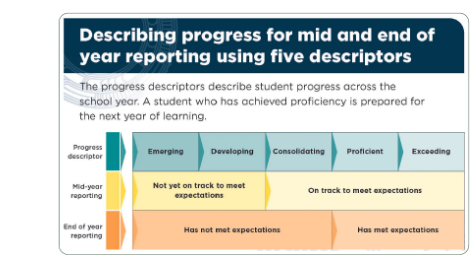
Your child’s report will use one of five descriptors to communicate their achievement in Reading, Writing and Mathematics.
- Emerging: Your child is beginning to develop the knowledge and skills expected at their year level.
- Developing: Your child is building their knowledge and skills but has not yet met the expected level.
- Consolidating: Your child is strengthening and applying their learning but has not yet met the end-of-year expectations.
- Proficient: Your child has demonstrated the knowledge and skills expected at their year level and is prepared for the next year of learning.
- Exceeding: Your child is demonstrating achievement beyond the expected level.
At the end of the year, Proficient and Exceeding indicate that a child has met expectations.
What If My Child’s Achievement Has Not Changed Since Mid-Year?
One of the most important messages we want to share with families is that a reporting descriptor does not tell the whole story of your child’s progress.
You may notice that your child’s achievement descriptor has remained the same since the middle of the year, or that their reported achievement looks different from previous years.
Please keep in mind:
- The curriculum expectations have shifted. Your child is now being assessed against updated expectations, which is more demanding than those used previously.
- Your child will have been learning and making progress throughout the year. This progress may be evident in their daily classroom work, growing confidence, understanding and independence, even when it is not reflected in a change of descriptor.
- A descriptor is not a measure of effort. A child may be working incredibly hard, making meaningful progress and still be developing the knowledge and skills needed to meet the new expectations.
- Progress takes time. Children learn at different rates, and developing secure understanding is more important than simply moving to the next descriptor.
For these reasons, we encourage families to be cautious about making direct comparisons between achievement judgements from previous years and those reported in 2026.
The Most Important Part: Your Child’s Next Steps
We strongly encourage you to read the next learning steps identified by your child’s teacher.
These are particularly valuable because they explain what your child needs to focus on to continue progressing.
We encourage families to:
- Celebrate the progress and achievements your child has made this year.
- Talk positively with your child about their learning, effort and successes.
- Read the next steps carefully and discuss them with your child.
- Continue supporting these learning goals at home through reading, writing, everyday mathematics and other meaningful learning opportunities.
- Encourage your child to persevere, practise and take pride in their progress.
Working consistently on these next steps, both at school and at home, will make a meaningful difference to your child’s continued learning.
Moving Forward Together
We recognise that this has been a year of considerable change in education. Our teachers have worked tirelessly to understand the new curriculum, strengthen their teaching practice and ensure that every child continues to receive quality learning opportunities.
As we become more familiar with the refreshed curriculum and assessment approaches, we will continue refining our practice and using assessment information to respond to the needs of our learners.
We remain committed to high expectations, excellent teaching and ensuring every child is supported to achieve their personal best.
Most importantly, we want every child to recognise that learning is a journey. A single achievement descriptor does not define their ability, potential or the progress they have made.
Thank you for your ongoing trust, encouragement and partnership. With our dedicated teachers, hardworking students and continued support from our families and whānau, we look forward to building on this year’s learning and celebrating further success in 2027.


 English
 Arabic
 Chinese (Simplified)
 Dutch
 Filipino
 French
 German
 Hindi
 Italian
 Japanese
 Korean
 Maori
 Portuguese
 Russian
 Samoan
 Spanish
 Thai